----- Original Message -----
From: Len Cranford
To: apopeeso@comcast.net ; pyrigenes
; Chris
D.
Sent: Monday, March 02, 2015 7:38 AM
Subject: So You Survived the Real Estate Dive of 2008;
[Here comes something bigger;]


Real Estate is Doomed – Part 1: The Fed
March 2, 2015 | Author Ramsey Su
Too Much Debt
The
Chair and the Vice Chair of the Fed both spoke last week. Janet Yellen
testified in front of the House and Senate with this speech. Stanley Fischer’s
speech was delivered here. They were basically the
same speech, Yellen’s just had more fluff for the politically motivated
audience.
The message was negative for housing. Allow me to elaborate.
Image via typepad.com
From a broader, and global perspective, the world has taken on too
much debt. This is a recent table from ZeroHedge:

Total debt-to-GDP ratios
(excl. financial debt) of assorted countries (Source: McKinsey, Zero Hedge)
We know
this mountain of debt is only made possible by the endless printing of all the
major central banks, namely the Fed, the ECB, the Bank of England, the Bank of
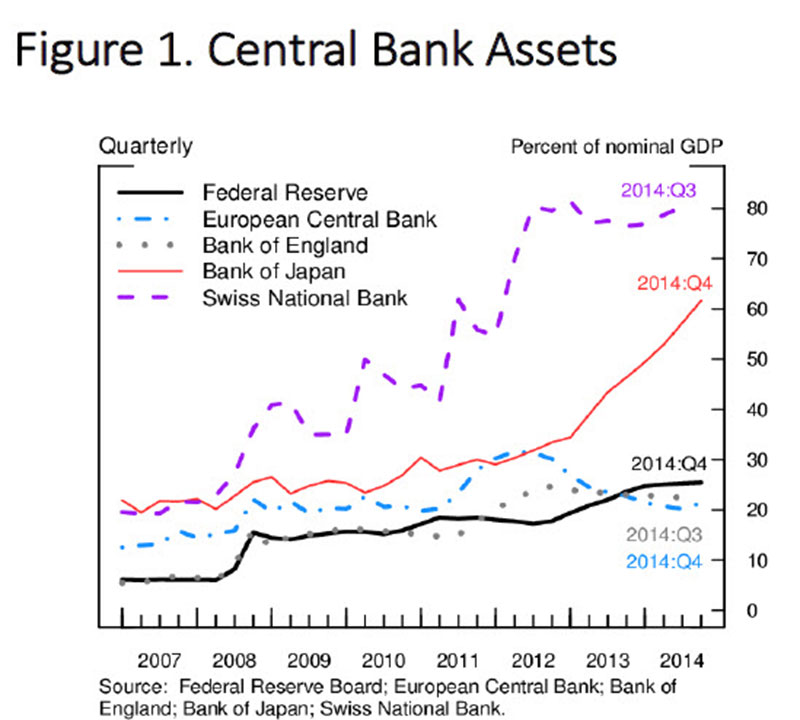
Japan and the SNB. Vice Chairman Fischer provided this batch of data on how much the
respective central banks have contributed in recent years:
 Central
bank assets as a percentage of nominal GDP – click to enlarge.
Central
bank assets as a percentage of nominal GDP – click to enlarge.
Fischer further pointed out that ECB is trailing the others only
because its QE operation is not yet underway. However, it has already been
announced and is starting soon. In terms of actual numbers, the Federal
Reserve’s balance sheet has risen from about $900 billion in 2006 to about $4.5
trillion today via QE1, 2, 3 and Operation Twist.
Mission Accomplished?
From their speeches, both Yellen and Fischer seem to have concluded
“mission accomplished“.
QE3 is done and their focus is now on when and how to remove the previously
provided accommodation. Does that make sense?
The world as a whole is not that much different from Greece.
No major economy is strong enough to support the debt it has taken on.
The modus operandi is to print, or if one is in a
position like Greece and can’t print, to try to borrow
from tomorrow to pay for yesterday, while going hungry today. Let
us look at how real estate fits into the big picture. This chart, also
from the Federal Reserve, speaks for itself:
 US 30
year fixed mortgage rate, average – click to enlarge.
US 30
year fixed mortgage rate, average – click to enlarge.
The above chart illustrates how mortgage rates have enjoyed
endless rounds of accommodation for about 35 years, since the time of Mr.
Volcker, the last Fed chairman with a spine. With so much accommodation
over such a long period of time, the question is, what has housing got to show
for it? As Ms. Yellen testified:
“[….]However, housing
construction continues to lag; activity remains well below levels we judge
could be supported in the longer run by population growth and the likely rate
of household formation….”
Given such a dire outlook, the Feds plan, as stated by Stanley
Fischer, consists of:
“[….] with regard to balance sheet
normalization, the FOMC has indicated that it does not anticipate sales of
agency mortgage-backed securities, and that it plans to normalize the size of
the balance sheet primarily by ceasing reinvestment of principal payments on
its existing securities holdings when the time comes….”
(emphasis added)
How can they be talking about weakness and tightening at the same
time?
Let us
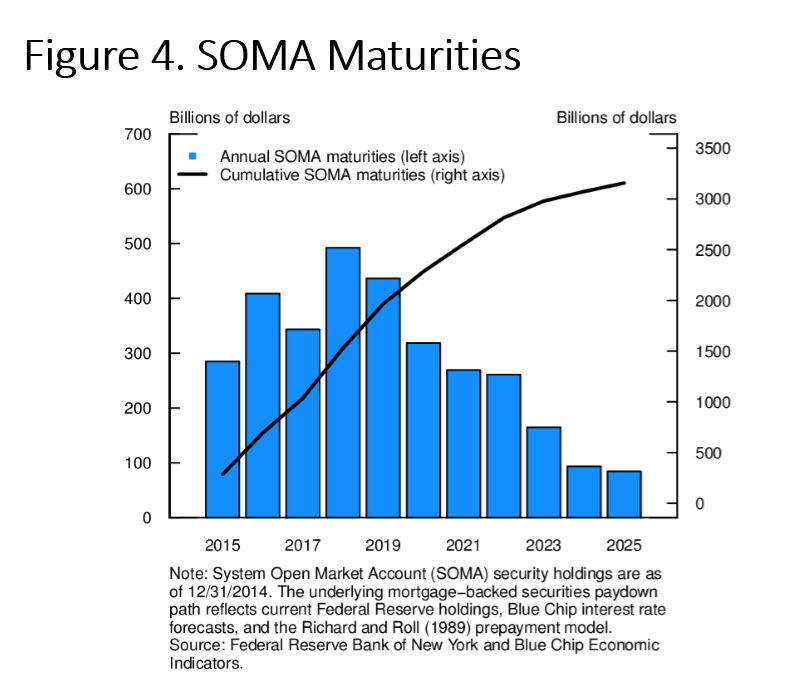
put some numbers behind the balance sheet normalization plan. This is
the maturity schedule of the Fed’s
assets:
 Maturity
schedule of assets held in the Federal Reserve’s system open market account –
click to enlarge.
Maturity
schedule of assets held in the Federal Reserve’s system open market account –
click to enlarge.
Year to date, the Fed has been purchasing approximately $6 billion
of agency MBS per week, equivalent to about $300 billion per year. This
matches the maturities almost exactly, leading me to conclude that the Fed has
not begun to normalize its balance sheet, but has merely not been adding to its
portfolio. Freddie Mac is estimating that there will be $1.3 trillion in
mortgage originations this year. Here are my questions:
Do Fed board members really think they can remove 25% of the
demand by not replacing maturing MBS, and the market will be strong enough to
absorb that?
Who in the world is going to step up and buy $300 billion in
mortgage backed securities in 2015, $400 billion in 2016, and so on?
Is the Fed expecting rates to go up, down or remain the same?
Conclusion
In conclusion, the real estate market survives by a continuous Fed
effort to accommodate. As one policy started running out of steam, a new
and improved policy was introduced to keep the momentum going. Providing
no new accommodation is equivalent to tightening.
The complacency in evidence today is not dissimilar to that seen
during the sub-prime era, when both Mr. Bernanke and Ms. Yellen admitted they
did not see the problems coming. The real estate market is now accustomed
to an ever increasing level of happy drugs. Now that the Fed has clearly come
to the end of providing additional support, withdrawal is going to be quite
painful.
Charts and tables by: Zerohedge/McKinsey, St. Louis Federal
Reserve Research


No comments:
Post a Comment