US airlines give in to China's demands over Taiwan
US airlines have begun changing their websites to keep China happy, just hours before a deadline for them to do so.
Beijing has demanded that American Airlines (AAL), Delta (DAL) and United (UAL) all change how their global websites refer to Taiwan by Wednesday, or potentially face sanctions in one of the world's biggest markets for air travel. All three are set to comply.




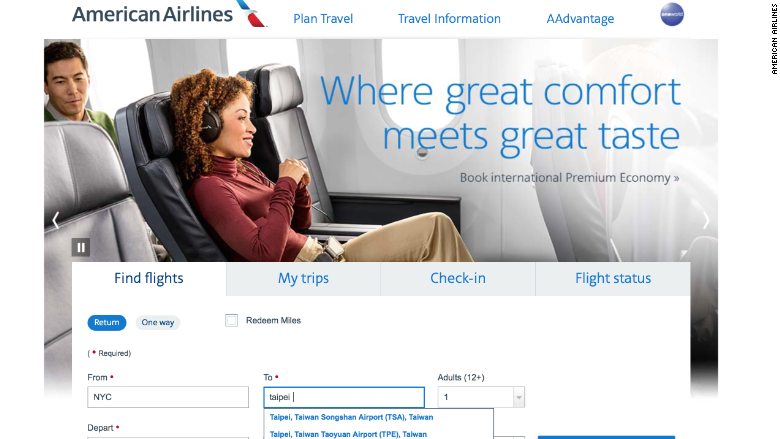
On Wednesday morning in Asia hours, American Airlines had updated its website to show that it simply flies to "Taipei," with no mention of Taiwan. A few hours earlier, the website said American Airlines flew to "Taipei, Taiwan."
A source familiar with discussions on the matter told CNN that other airlines including Delta and United would change how their websites refer to Taipei in the next 24 to 48 hours. The source didn't specify how exactly the carriers would update their websites.
China and Taiwan have been governed separately since 1949 following the Communist victory on the mainland after a civil war, although a shared cultural and linguistic heritage mostly endures.
But China considers Taiwan to be an integral part of its territory, and comes down hard on any suggestions to the contrary.
"Like other carriers, American is implementing changes to address China's request. Air travel is global business, and we abide by the rules in countries where we operate," American spokeswoman Shannon Gilson told CNN.
Delta and United did not respond to requests for comment outside of regular office hours.
"As with other sectors of the economy, the US airline industry is a global business that must contend with a host of regulations and requirements," US airline industry trade association Airlines For America (A4A) said in a statement Tuesday.
"A4A and the affected US airlines appreciate the engagement and counsel we have received from the administration as carriers begin to implement a solution," it added.
The instructions from China provoked a strong reaction from the United States earlier in the year. The White House slammed the demands as "Orwellian nonsense," describing them as "part of a growing trend by the Chinese Communist Party to impose its political views on American citizens and private companies."
But international airlines and other global brands are caught in a bind. It's vital for their business that they stay in China's good books. The International Air Transport Association forecast last year that China would surpass the United States as the world's top aviation market by 2020.
Many airlines, such as Australia's Qantas (QABSY), Air Canada (ACDVF) and Air India, have already agreed to change their websites.
China hasn't spelled out what the punishments might be for airlines that fail to comply with its demands.
Earlier this year, it blocked Marriott (MAR) websites and apps for a week in the country after the hotel company listed Tibet, Hong Kong, Macau and Taiwan as separate countries in emails and apps.
Hong Kong and Macau are former European colonies that were returned to China in the late 1990s, becoming regions with a large degree of administrative autonomy. Tibet has been under Beijing's control since 1951.
Marriott issued a profuse public apology over the matter and conducted a full review of its Chinese website and apps.
China has orchestrated boycotts of foreign companies in the past. Last year, it squeezed the economy of South Korea, which had angered the Chinese government with the deployment of a US missile defense system.
The measures included an unofficial order to Chinese travel agencies to halt tour groups to South Korea. Within months, the number of Chinese tourists visiting the country had fallen by almost 50%, hurting South Korean operators of hotels, duty free stores and other travel businesses.
-- Tim Schwarz contributed to this report.


No comments:
Post a Comment