April 1941: Operation “Marita” and the Greek “Maginot Line” that cost the nazi Germans dearly.
On October 28th, 1940, fascist
Italy launched an unprovoked and ultimately disastrous attack on Greece which
signaled it’s entry in World War Two.
Following the stalemate of their
Italian allies in the Albanian front and the victories of the Greeks in the
mountainous regions of northern Greece and Albania against the Italian army,
the German dictator Adolf Hitler initiated the preparation for Operation
“Marita”.
On April 6th, 1941, Nazi Germany
started their offensive against Greece.

The Nazi German offensive against Greece, April 1941
General Ioannis Metaxas, the Greek
dictator-prime minister who died shortly before the German invasion of his
country, had initiated this construction project in the summer of 1936.
Its strongest part extended over a
distance of 200 kilometers (125 miles) from the mouth of the Nestos River
to the point where the Yugoslav, Bulgarian, and Greek borders meet.

Only direct artillery hits would silence the bunkers.
The fortresses within this defense
system blocked the road that led through the basin of Nevrokop and across the
Rupel Gorge to eastern Macedonia.
The strength of the Metaxas Line
resided not so much in its fortifications proper as in the inaccessibility of
the intermediate terrain leading up to the defense positions.

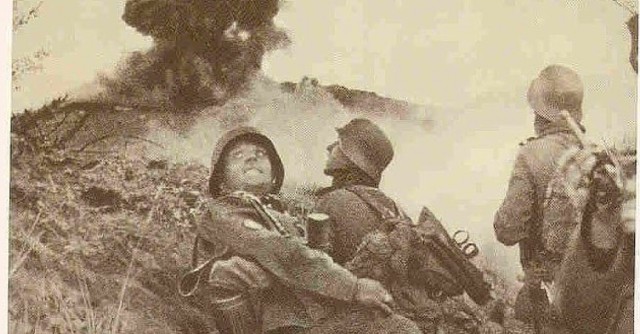
Rare photo of the bunkers at Metaxas Line during the fight.
The Greek fortifications along the
border had been skillfully adapted to these terrain features and a defense
system in depth covered the few available roads. No continuous fortifications
had been erected along the Yugoslav-Bulgarian border, but road blocks,
demolitions, and extensive mine fields had been prepared at all border points.
The German plan of attack was based
on the premise that, because of the diversion created by the campaign in
Albania, the Greeks would lack sufficient manpower to defend their borders with
Yugoslavia and Bulgaria.

Aerial bombardment, mainly by Stukas, of the “Metaxas Line”, had minimal effect to the fortifications and the morale of the Greek soldiers
The frontal attack on the Metaxas
Line, undertaken by one German infantry and two reinforced mountain divisions
of the XVIII Mountain Corps, met with extremely tough resistance from the Greek
defenders.
After a three-day struggle, during
which the Germans massed artillery and dive bombers, the Metaxas Line was
finally penetrated.
Some of the fortresses of the line
held out for days after the German attack divisions had bypassed them and could
not be reduced until heavy guns were brought up.
The main credit for this
achievement must be given to the 6th Mountain Division, which crossed a
7,000-foot snow-covered mountain range and broke through at a point that had
been considered inaccessible by the Greeks.

Nazis contemplate over the grave of their comrades.
The division reached the rail line to Salonika on the evening of 7 April and entered Kherson two days later.
By driving armored wedges through
the weakest links in the defense chain, the freedom of maneuver necessary for
thrusting deep into enemy territory could be gained more easily than by moving
up the armor only after the infantry had forced its way through the mountain
valleys and defiles.
Once the weak defense system of
southern Yugoslavia had been overrun by German armor, the relatively strong
Metaxas Line, whicl1 obstructed a rapid invasion of Greece from Bulgaria, could
be outflanked by highly mobile forces thrusting southward from Yugoslavia.
Possession of Monastir and the Vardar Valley leading to Salonika was essential
to such an outflanking maneuver.

Nazis monitor the mountainous region that was part of the “Metaxas Line.”
When Operation Marita began on 6
April, the bulk of the Greek army was on the border with Albania, then a
protectorate of Fascist Italy, from which the Italian troops were trying
unsuccessfully to enter Greece.
German troops invaded through
Bulgaria, creating a second front. Greece had already received a small though
inadequate reinforcement from British Empire Forces, in anticipation of the
German attack but no more help was sent after the invasion began.
The Greek army found itself
outnumbered in its effort to defend against both Italian and German troops.
When German troops officially entered
Bulgaria during the first four days of March, the British reacted promptly by
embarking an expeditionary force in Alexandria.
Several squadrons of the Royal Air
Force as well as antiaircraft units had been operating in Greece during the
previous months.


No comments:
Post a Comment