E.I.R.STRATEGIC ALERT
WEEKLY NEWSLETTER
Volume 33, No. 6, February 7, 2019
Donald Trump Takes on the Coup Faction
in the Intelligence Community
In an astonishing display of insubordination by the nation’s “intelligence chiefs” against their Commander-in-Chief, Dan Coats,
the Director of National Intelligence, CIA Director Gina Haspel,
and FBI Director Christopher Wray took turns deriding the strategic policy of Donald Trump before the Senate Select Committee on Intelligence on Jan. 29. They were there to present
the 2019 Worldwide Threat Assessment of the US Intelligence
Community report, which was released on Jan. 29 to rave reviews from the anti-Trump, pro-British imperial establishment.
As Trump prepares for a summit with Kim Jong-un, they
asserted that the North Korean leader will never give up his nuclear weapons. Syrian withdrawal, they said, is nothing but an
opening for the revival of ISIS, including terror threats against
the United States. As for collaboration with Russia and China,
according to these three caretakers of the discredited school of
British geopolitics, they represent an aggressive threat against
the U.S. and its allies, proven by the “meddling” of Russia in
the 2016 U.S. elections (which, by the way, has never been
proven!).
Trump took to twitter, denouncing them as “naive”. He said
that the relationship with North Korea is “the best it has ever
been,” that ISIS has been defeated, and added that negotiations
in Afghanistan are “proceeding well...after 18 years of fighting.” Asked by a reporter if he has confidence that Haspel and
Coats give him good advice, he responded bluntly: “No... I think
I’m right. Time will prove me right, probably.”
President Trump’s opponents immediately pounced, led by
Sen. Charles Schumer, who called for U.S. intel officials to
“stage an intervention” with Trump – to “insist on an immediate
meeting...to educate him”. Several Republicans also turned on
Trump, such as Senate Whip John Thune, who defended Coats,
and Sen. Mitt Romney, who expressed “full confidence in our
intelligence community.” The Washington Post editorialized on
Jan. 31 that the intel officials left “one serious threat off their
list: that of a president mired in his own delusions who refuses
to hear the truth.”
After meeting with the intel officials, Trump played down the
disagreements, dismissing much of the controversy as a “media” operation. But he was clear that he will not be influenced by
such “assessments,” reiterating his views of progress, especially
with North Korea and the Middle East, e.g., Syria and Afghan
withdrawals. He also had praise for China, saying that there
was “tremendous progress” in the trade talks, and he looks forward to meeting soon with President Xi Jinping. In an interview
with CBS, Trump brought up the assessment of the intelligence
agencies on the alleged weapons of mass destruction of Saddam
Hussein, which turned out to be completely wrong, but “they
got us tied up in a war that we should have never been in.”
Needless to say, those defending the “old paradigm” of British geopolitics, with endless war and regime change coups as
their domain, are not impressed. The Senate voted 68 to 23 to
reject the withdrawal of troops from Syria. While this is a nonbinding resolution, it epitomizes the determination of those out
to break Trump by sabotaging his initiatives.
This proves that Trump’s quip was on target, when he said
his intelligence chiefs “should go back to school.” Better yet,
though, he could fire them all!
U.S.-China Trade Talks Advance,
Despite Attempts at Sabotage
After two days of trade talks between the U.S. and China, described by both sides as “intense and productive”, President
Trump expressed his excitement about the potential agreement,
following a meeting with Vice-Premier Liu He, who headed the
Chinese delegation in Washington. Anticipating that the areas of
disagreement between the two nations can be overcome in the
next round of talks, he said of the potential agreement that “It
will be, by far, if it happens, the biggest deal ever made”.
Liu brought with him letter to Donald Trump from Xi Jiinping, which was read at the opening of the Jan. 31 meeting at
the White House. Xi wrote: “I cherish the good working relations and personal friendship with you. I enjoy our meetings
and phone calls, in which we could talk about anything.” Trump
himself noted the “tremendous” progress that had been made
in the talks, and added that he will likely be meeting Xi soon,
which he said would be necessary to finalize a deal.
The trade talks took place under a cloud created by an action
of the U.S. Department of Justice (DOJ), which had announced
just two days earlier indictments totaling 23 counts, against
Huawei, the China-based telecommunications conglomerate.
The indictments were filed in Seattle and Brooklyn, with charges ranging from stealing U.S. technology, to violating sanctions
against trade with Iran and bank fraud. The CFO of Huawei,
Meng Wanzhou, was arrested in Vancouver by Canadian authorities, in collaboration with the DOJ, on Dec. 1, 2018, at the
same time that Presidents Trump and Xi were meeting at the
G20 summit in Buenos Aires.
Meanwhile, in Congress, members of both parties were tar-
EIR STRATEGIC ALERT 2 WEEKLY NEWSLETTER n°6 / 2019
geting China as an adversary, both in discussion of the Worldwide Threat Assessment Report (cf. above), and in legislation
against Chinese companies. A bill to ban the sale of U.S. chips
and other components to Huawei, ZTE and other China tech
firms will be introduced this week, sponsored by two Republicans and two Democrats, who called Huawei an “intelligence
gathering arm of the Chinese Communist Party” and a “fundamental risk to American national security.”
The Chinese press has denounced the arrest of Meng and the
indictments against Huawei as an attack on China’s leadership
in telecommunications and related technologies, and as a calculated effort to disrupt the trade talks. One expert noted that
the attacks on Huawei began, not surprisingly, in the U.K., with
the British government demanding in July 2013 that the GCHQ
(intelligence agency) provide oversight of the firm’s Cyber Security Center in the U.K. China’s telecom equipment maker ZTE
was also targeted by the GCHQ as presenting “national security risks”. This is the same GCHQ which launched “Russiagate”
against Trump back, calling attention to alleged suspicious Russian cyber activity related to the U.S. presidential campaign.
After 70 Years, Time to End the Korean War
As Washington and Pyongyang make preparations for a second
summit meeting at the end of the month between Kim Jungun and Donald Trump, U.S. Special Representative for North
Korea Stephen Biegun arrived in Seoul on Feb. 3 to meet with
his South Korean counterpart Lee Do-hoon the next day prior
to talks on Feb. 5 with his North Korean counterpart Kim Hak
Chul, to discuss the roadmap toward denuclearization of the
peninsula.
In an interview with CBS-News on Feb. 1, that aired on Feb.
3, Trump said: “We’ve made tremendous progress. If you remember, before I became President, it looked like we were going to war with North Korea. Now we have a very good relationship.”
Trump thus defended his policy of dialogue and negotiations
that the US intelligence community is attempting to derail (cf.
above). In testimony to the US Senate on Jan. 29, the Director of National Intelligence Dan Coats had stated that Pyongyang was “unlikely” to proceed with denuclearization, although
it would continue to negotiate partial steps in order to gain
concessions from Washington. In other words, Trump is being
duped by Kim.
Special Representative Biegun also disagrees with the presentation by the intelligence community. At a speech at Stanford
University on Jan. 31, he said he entirely shared “President
Trump’s frustration with the way this intelligence information
was briefed and played out.”
Biegun spelled out US policy as follows: “President Trump
is ready to end this war. It is over. It is done. We’re not going to invade North Korea. We are not seeking to topple the
regime....” The U.S. “has a leader who, more so than any previous President, is deeply and personally committed to once and
for all bringing an end to 70 years of war and hostility on the
Korean Peninsula.” That process will be long and difficult, he
indicated, so it “is fair to say we have more work ahead of us
than behind us.”
According to Joel Wit, one of the main negotiators of the
1994 agreement with Pyongyang, many of his contacts in the
intelligence community now recognize that their earlier forecasts regarding how the North Korean leadership would act
have been proven wrong. That may well be because the North
Koreans have now been offered an approach outside the box of
geopolitics.
Italy Moves to Stabilize Strategic Situation
The Italian government has launched significant initiatives in the
recent period for conflict-avoidance, in particular as regards the
crisis in Venezuela and the need to improve relations with Russia, in addition to its forceful promotion of cooperation with
China’s Belt and Road Initiative.
* At the Bucharest meeting of EU Foreign Ministers on Jan.
31, the “imperialist” faction tried to push through a statement
recognizing insurgent Juan Guaidó as President of Venezuela
until new elections are held, but it was blocked by a group of
member states led by Italy. It was not a formal recognition, but
an implicit one. Italy, together with Austria, Finland and Greece,
rejected that resolution. Rather than accepting the defeat, some
nations led by Britain and France went their own way and unilaterally recognized Guaidó on Feb. 4.
The European Parliament on the contrary recognized Guaidò
in a resolution approved on Jan. 31. The EP is dominated by
social-democratic and so-called “popular” (christian democratic)
parties.
Italian Deputy Premier Luigi Di Maio of M5S stated that “Since
we have already been hurt by other states’ interference [referring to France’s interference in Libya -- ed.], we don’t want to
go so far as to recognize subjects who have not been elected.”
* Speaking to the Russian Federation Council, the legislature’s
upper house, Italian Senate President Maria Elisabetta Alberti
Casellati issued a strong call to end the anti-Russia hysteria and
establish cooperation for peace and development among the
major powers.
“One of the reasons why we believe that close cooperation
between Russia and Italy, Russia and Europe, Russia and the
West is crucial, is because we understand the most important
role your country plays in maintaining the fragile balance on the
international stage,” she told the Russian Senators, a role “that
may prove crucial in the face of the serious threat to global
peace,” TASS reported Jan. 30.
Alberti Casellati pointed to Russia’s task in stabilizing conflict
zones and “fighting terrorism in its many manifestations”, and
called for greater cooperation to ensure stability and global security. She also pointed out that the European Union, NATO,
and Russia needed to create conditions to overcome sanctions,
which were harmful to all, and to build a dialogue based on
common features, instead of emphasizing differences. “Without
a doubt, there is more than a link but a set of features shared by
Russia and Europe. There can be no talk of European civilization
without Russia.”
Germany Has “World’s Dumbest Energy Policy”
The above title is the headline of an editorial in the Jan. 29 Wall
Street Journal, written after Germany’s Coal Exit Commission
concluded its final session with the recommendation to end coalfired power generation by 2038. “Having wasted uncountable
billions of euros on renewables and inflicted some of Europe’s
highest energy prices on German households and businesses,
now Berlin is promising to kill the one reliable power source
Germany has left,” the WSJ warned. Indeed, experts throughout the world are wondering how Germany intends to remain a
leading industrial nation after 2038, if it eliminates coal, which
together with nuclear power (to be shut off by 2022) still accounts for nearly one half of the nation’s power supply.
The government’s policy to completely phase out coal-fired
power plants by 2035-2038 would not only result in higher
electricity prices for German industry and private households,
but in a chronic undersupply of power as well. Wind, solar and
biomass cannot suffice. Will neighbouring Poland and the Czech
EIR STRATEGIC ALERT n°6 / 2019 WEEKLY NEWSLETTER 3
Republic continue to export electricity to Germany’s eastern regions (generated by coal and, in the case of the Czech Republic
by nuclear power)? Will Austria and Switzerland continue to
supply electricity from their hydropower, and France from its
nuclear plants to the western and southern regions? And how
can Germany’s energy-intensive industries with their several
million jobs survive in such a future? Already now, operating a
coal-fired power plant is becoming a high risk for the utilities,
or is made impossible as in the case of Uniper’s plant Datteln IV
-- the most modern of its kind in Europe -- which the Coal Exit
Commission recommends should not go on the grid in 2020.
The €1.5 bn euros invested would be lost.
While the climate protection lobby in Germany likes to boast
that “nearly 40%” of the national power supply comes from
“renewables” like solar, wind and biomass, they fail to say this
figure is due to the administrative suppression of “non-renewables:” Lignite is down to 22.5%, hard coal down to 14%,
nuclear down to 11.7%, hydropower down to 5.2%, while
natural gas, now at 13.2%, is the next target of the environmentalists, including for geopolitics reasons as most of the gas
comes from Russia.
The cost of the march into the renewables era is enormous:
€25 bn annually (!) to promote and subsidize solar, wind and
biomass; €40 bn in total for the shutdown of the lignite and
coal sector over the next 17-20 years; plus 2 bn annually slated
to subsidize end-consumer prices for electricity and heating
which will shoot up. Already now, the corporate electricity bill
is twice as high for German firms than in neighboring France,
where 69% of the electricity consumed, and 17% of the energy
consumed still come from nuclear power plants.
Interview with Jacques Cheminade
on the Yellow Vest Phenomenon
As the Yellow Vest movement in France enters its 13th week, it
has drawn considerable attention internationally, and spawned
a number of protest initiatives in other European countries.
Former French Presidential candidate Jacques Cheminade was
asked to give his insight into the movement during a 27 minute
interview to Sophie Shevardnadze of RT, which was posted in
full on Feb. 2, under the title “Yellow Vest protests resemble
beginning of French Revolution”.
The protest movement, Cheminade stressed, has deep roots
throughout the country, bringing together those who consider
themselves to be the “forgotten majority”, who are now standing up to proclaim “we are the people”, and demand greater
social justice. What they intuitively understand, he said, is that
the French elites have submitted to “financial globalism”, that
the world financial markets and the European Central Bank hold
the power which the government should have, and should wield
to protect the general welfare.
Asked about the apparent lack of leaders in the movement,
with whom the government could negotiate, Cheminade noted
that “in a way it’s very different, but it looks like the beginning
of the French Revolution, when there were no leaders.” These
people didn’t know each other, most of them had never gone to
demonstrations, he explained, they are craftsmen, middle-class
people from a working-class background who understand that
“the emperor has no clothes” – the emperor being the ruling
class and politicians – and suddenly they wanted to join together. “The level of respect for politicians at this point in France is
9%, and the most respected thing is the public hospital, which is
90%, so you have that.... Rosa Luxemburg in the old days called
that a mass strike ferment, it’s a ferment.”
There are attempts to launch a list of candidates for the European elections, but Cheminade believes that Emmanuel Macron
himself has a hand in that, because he “expects that a list of Yellow Vests would siphon votes out of the extreme left, extreme
right and out of the center-right opposition.” (And thereby
strengthen his own movement, which in parentheses is at an
abysmal level.)
Despite all the differences inside the movement, Cheminade
believes that what they all want is to be able to participate in
the policy-making, but they need to be educated in how society
functions. “They know it functions in a wrong way, but they
don’t know how to make it function in a right way, and my
job as a, let’s say, dissident politician, is to organize them to
understand what they have to do positively. It’s difficult, it will
be an educational task which will take a long time, but it’s very
interesting.”
Cheminade stressed that the issue is not really raising taxes
on the rich or lowering those on the poor, it’s the need to create wealth in society, and you do that by issuing public credit to
invest in the future. Interestingly, banners have appeared in the
demonstrations calling for the renationalization of the Banque
de France.
Cheminade’s Solidarité et Progrès party calls for the creation
of a true national bank to finance the state and the projects
needed. For that, the state must control the issuance of currency and of public credit. And that, in turn, demands a break
with the European Union in its current form.
Israeli Military Leaders
Prepare Challenge to Bibi Netanyahu
Two former Chiefs of the General Staff of the Israeli Defense
Forces (IDF) could soon be joined by a third to try and unseat
the right-wing Prime Minister Benjamin Netanyahu in the general elections on April 9. When the slate is fully formed, it will
be led by Gen. Benny Gantz (ret.), the Chief of Staff in 2011-
2015, who already has an election alliance with Gen. Moshe
Ya’alon (ret.), who was Chief of Staff in 2002-2005, and Defense Minister in 2013-2016.
Gantz held his first electoral rally in Tel Aviv on Jan. 28,
where he roundly denounced Netanyahu, comparing him to the
France’s Louis XIV. “The current regime [sic] encourages incitement, subversion and hatred,” he said. “The basic values of Israeli statehood have been converted into the mannerisms of a
French royal house....
“It does not see the working man and the working woman.
It does not see families moaning under the cost of living and the
young people who cannot buy an apartment.
“There was already a king who said: ‘The State is me.’ But no.
Not here...No Israeli leader is a king. The state is not me. The
state is you. The state is actually us. The state is all of us. The
government we will form will be a national government and not
a monarchy.”
Ya’alon attended the rally, where he announced that his
Telem Party (acronym for Tnua Leumit Mamlachtit, or National
Statesmanlike Movement) had formed an electoral alliance with
Gantz’s Israel Resilience Party (“Hosen Yisrael” in Hebrew).
While demanding an end to corruption and incitement, and
for uniting all sectors of the Israeli population -- left and right,
Jewish and Arab, secular and religious -- it is not fully clear
what their policy on reopening the peace process will be.
The two former military leaders have invited Lt. Gen. Gabi
Ashkenazi who was Chief of Staff from 2007-2011, to join
their alliance. Ashkenazi is said to be considering entering politics, but has yet to make a decision.
According to one Italian political analyst who divides the world
between “globalists” and “Westphalians,” Gantz belongs to the
latter faction while the current PM is a globalist.
EIR STRATEGIC ALERT 4 WEEKLY NEWSLETTER n° 6/ 2019
While initial polls, which in Israel have not been very reliable,
show that Gantz’s popularity has reached parity with Netanyahu, Gantz’s party is still trailing Netanyahu’s Likud party, whose
machine will for sure be greased with the donations he hopes to
obtain from his big business and foreign supporters.
Meanwhile, Netanyahu is attempting to brand Gantz as a
“leftist”, in order to scare away center right voters, a group
that has increased in the Israeli population after 10 years of
Netanyahu-led governments.
Venezuelan Crisis:
a Classic “Gang-Countergang” Operation
Events in Venezuela of the past two weeks have occurred at
a dizzying pace: the sudden emergence of the self-proclaimed
interim President Juan Guaidó, his recognition by the U.S.,
Canada and many Western and Ibero-American governments,
and the demand that the “dictator,” Venezuelan President Nicolás Maduro, step down “or else.” Pressures have intensified
in just the past few days, as “Manchurian Candidate” Guaidó,
a relative unknown, has provocatively announced a plan to establish “humanitarian corridors” into Venezuela, using the same
“Responsibility to Protect” strategy (R2P) that globalists used
to violate the territorial sovereignty of Libya, Syria and many
other nations.
Neocons inside the Trump cabinet are hinting at a possible
military option, and the Treasury has imposed sanctions on the
state oil firm PDVSA, in an attempt to squeeze the country economically. Thus the stage is set for worse upheaval. But, none of
this could have happened without the London-created and -directed Jacobin operation of the 1990s, first with Hugo Chávez
and continued by his anointed successor Nicolás Maduro -- an
operation which EIR has thoroughly documented. “Chavismo”
forged a strategic alliance with the FARC cocaine cartel (also run
out of London) and wrecked Venezuela economically and politically, setting it up for what is now taking place: a “color revolution,” financed by the National Endowment for Democracy
(NED), the National Republican Institute, USAID, the National
Democratic Institute, and a variety of George Soros-allied nongovernmental organizations.
This is a classic gang and counter-gang operation, which is
also essential to the London-directed coup against U.S. President Trump. His warmonger advisers on Ibero-America policy,
in his cabinet, the State Department, National Security Council
and among leading members of the Florida-based Cuban exile
community, charge that Russia and China are the real culprits in
the Venezuelan crisis, “undermining U.S. national security interests” in the region through their economic, political and military
ties to Venezuela and other nations. The goal is to make impossible any U.S. cooperation with Russia and China in the region,
through the Belt and Road Initiative.
The Wall Street Journal put it quite baldly in a Jan. 31 article,
entitled, “U.S. Push to Oust Venezuela’s Maduro Marks First
Shot in Plan to Reshape Latin America.” This reshaping is also
to include regime change in nations such as Cuba and Nicaragua,
as per the narrative laid out by neocon National Security Adviser
John Bolton, who named all three nations last Nov. as the dangerous “troika of tyranny” to be overthrown.
There is real popular rage and despair in Venezuela over the
catastrophic humanitarian crisis created by both Chavez and
Maduro. But as investigative journalists Max Blumenthal and
Dan Cohen document in a Jan. 29 article in the Grayzone, those
being hailed in Western media as saviors of Venezuelan democracy, like Juan Guaidó, are frauds. They are neoliberal oligarchs
selected and groomed by institutions associated with the Gene
Sharp networks to foment “revolution” and be tossed aside
when they have outlived their usefulness.
Who Is Juan Guaidó?
In sum, he is a nobody. He was a student leader recruited in
2005 and sent to Belgrade, Serbia sponsored by the Center for
Applied Non-Violence and Strategies (CANVAS), an offshoot of
OTPOR (“Resistance” in Serbian), a movement that was instrumental in overthrowing Serbia’s Slobodan Milosevic. Financed
by the NED and USAID, OTPOR trained members of what became Venezuela’s “Generation 2007,” which led violent protests
against Chavez and then Maduro.
As investigative Venezuelan reporter Diego Sequera noted,
Guaidó is more popular outside of Venezuela than inside, “especially in the elite Ivy League and Washington circles.” In 2007,
he enrolled in the Governance and Political Management Program at George Washington University, in Washington, D.C.
where he studied under rabid Friedmanite economist Luis Enrique Berrizbeitia, a former executive director of the International Monetary Fund.
Guaido helped form the Popular Will party, together with the
former mayor of a district of Caracas and his mentor Leopoldo
Lopez, a Princeton-trained oligarch. In an interview to RT, investigative journalist Max Blumenthal described the Popular Will
as “the most violent, radical right-wing party in Venezuela functioning as shock troops of oligarchy,” and hated by those who
want to avoid civil war.
Mexico: LaRouche Organization Exposes
Apparatus Behind Black Market Theft of Oil
The MOCILA (LaRouche Citizens Movement of Mexico) issued
a statement on Jan. 26 supporting the fight against illegal oil
theft engaged by President López Obrador. It involves a highly-organized operation which for decades has been stealing a
huge percentage of the petroleum, gasoline and other products
produced by Mexico’s state oil company, Pemex The MOCILA
statement, which was published in full in regional newspapers
in Monterrey and Hermosillo, points to the “complex multinational enterprise” behind the operation, which runs all kinds of
criminal business activity in the world.
“That multinational is the apparatus which has unleashed terrorism against Mexico, through its division which runs the macabre drug trade which yields some $1 trillion in sales per year.
Other divisions of that multinational company run arms trafficking, human trafficking, the gold and diamond black market, and
of course it also runs the theft of petroleum and oil byproducts-
-all of which provides them with another $1 trillion per year.
The kingpins who run this business are obviously not the people
who tap the oil pipelines, or sell drugs in the streets, nor are
they the ones who prostitute adolescent girls; they do not carry
out the carpentry of those activities on the world’s black markets that they have intentionally created. Those kingpins are in
the financial and banking centers of the most important global
banks of the planet.
E.I.R. STRATEGIC ALERT www.eir.de
Published by: E.I.R.GmbH, Bahnstr. 4, 65205 Wiesbaden
Tel.: 0611/73650, Fax: 0611/9740935, Email: info@eir.com
Verantwortl. f. d. Inhalt: Dean Andromidas, Claudio Celani
Subscription: EUR 3000/ ISSN 0936-7527
© E.I.R. GmbH Alle Rechte vorbehalten, auch die des Nachdrucks
von Auszügen, derphotomechanischen Wiedergabe und der Übersetzung


 GETTY IMAGES
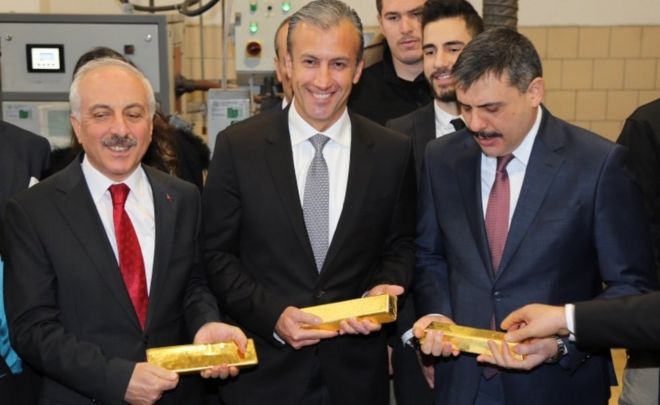
The Turkish government is coming under renewed pressure to stop buying gold from Venezuela, the BBC has learned.
A senior Western diplomatic source told the BBC that Turkey was now considered the main concern among the countries engaging in the trade.
They added that there are growing suspicions that gold exported to Turkey was ending up in Iran, which would violate US sanctions.
Turkish President Recep Tayyip Erdogan backs Venezuelan President Nicolás Maduro, who is facing a growing political challenge.